



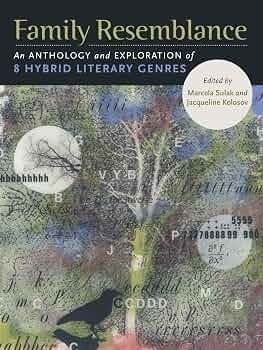
The Architecture of Modern Fracture
Contemporary literature increasingly distrusts the clean borders once drawn between poetry, essay, memoir, and fiction. A poem may carry the evidentiary pressure of a document; an essay may move by image, rhythm, and association; a personal narrative may interrupt its own chronology to question the reliability of memory. Such writing does not represent a failure to choose a genre. It reflects a more accurate understanding of how experience is actually perceived, remembered, and articulated.
The pressures of modern life make this formal restlessness especially legible. Attention is frequently divided, identities are layered, and private histories are shaped by public systems that cannot be understood through a single register. The mind may move from an image to an argument, from bodily sensation to historical fact, within a single moment. Hybrid writing gives that movement a deliberate architecture. Its fragmentary appearance can therefore be highly controlled, allowing discontinuity to become not a defect but a method of truth.
A hybrid collection that brings together verse, micro-memoir, and critical reflection should be understood as an essential cultural artifact rather than a marginal curiosity. It records the conditions under which contemporary consciousness operates while preserving the intensity of literary form. Its significance lies not merely in combining materials, but in discovering what becomes possible when those materials are made to challenge, revise, and illuminate one another.

The Anatomy of Interactivity Across Form
Susanne Paola Antonetta offers a particularly useful account of genuine hybridity. In the interview “On Hybridity”, hybridity is defined not as the simple accumulation of genres but as an interaction among different modes of meaning-making. Language, visual material, documentation, genre, and image must exert pressure on one another. An illustration that merely decorates a poem does not create a hybrid form; a photograph that changes how the accompanying prose is interpreted does.
This principle distinguishes a serious hybrid collection from a superficial collage. The most compelling works establish a cross-current between their components, so that each mode alters the reader”s understanding of the others. A lyric passage may compress an emotional event that a prose section later contextualizes. A critical reflection may expose the assumptions concealed within a personal memory. A fragment may refuse the certainty suggested by a completed narrative. The resulting work asks not only what each section means, but why it has been shaped in that particular form.
The lineage is long. The history of prose poetry demonstrates how writers have repeatedly dissolved the rigid distinction between verse and narrative exposition. Lyrical prose, poetic essay, epistolary meditation, and documentary fiction have all developed methods for joining compression with scope. Contemporary hybrid collections inherit this ambition while extending it through new combinations of memoir, criticism, visual structure, and digital influence.
- Reciprocal form means that each mode changes the force of the others.
- Strategic fragmentation uses gaps, shifts, and interruptions to represent the instability of memory or perception.
- Modulated scale moves between the intimate instant and the wider historical or intellectual frame.
- Formal consequence ensures that the structure does not merely contain the subject but actively performs it.
These mechanics matter because hybrid literature is not defined by novelty alone. Its success depends on necessity. When a writer turns from a paragraph to a stanza, or from testimony to analysis, the transition should reveal something that a single form could not hold. The most accomplished collections make these shifts feel inevitable in retrospect, even when they remain surprising in the moment.
Why Conventional Classifications Fail Contemporary Reality
Traditional publishing categories were designed to make books legible to commerce. Bookstores require shelves, retailers require metadata, and publicity departments need concise descriptions that allow a title to be positioned beside comparable works. These systems are practical, but they are poorly suited to manuscripts whose central achievement lies in refusing a single classification. A collection that is simultaneously poetry, memoir, and criticism can become difficult to place before its artistic value has even been considered.
The difficulty is intensified by expectations surrounding point of view and narrative contract. Conventional publishing guidance often treats first person and third person as strategic choices within recognizable forms. First person offers immediacy and subjective immersion, while third person can widen perspective and disclose information beyond one character”s awareness. Hybrid writing may use both, or may abandon stable narratorial identity altogether. A lyric “I” can become a historical witness, a critical observer, or a constructed voice without announcing the transition in conventional terms.
This flexibility is not evasive. Trauma, migration, illness, inherited memory, and contested identity often resist a smooth chronological account. A personal history may require the precision of documentary prose, the silence of the fragment, and the associative force of poetry. Jane Friedman”s discussion of nonfiction techniques makes a related point: narrative, character, suspense, conflict, and an arc of change can deepen factual writing without compromising its credibility. Hybrid authors extend that principle by allowing several kinds of truth to occupy the same book.
| Publishing expectation | Hybrid alternative | Literary consequence |
|---|---|---|
| One dominant genre | Several mutually dependent modes | Meaning emerges through formal tension |
| Stable narrative voice | Shifting or layered speakers | Identity becomes process rather than fixed position |
| Linear progression | Fragments, returns, and juxtapositions | Memory and interpretation shape chronology |
| Single shelf category | Cross-category readership | The book travels between literary communities |
Metadata may therefore describe a hybrid book imperfectly, but imperfect classification does not diminish its cultural clarity. Indeed, the friction between manuscript and marketplace can reveal how narrowly literary institutions have defined readability. Some authors respond through independent publishing, specialist presses, or carefully framed descriptions that foreground the work”s governing question rather than its category. The objective is not to evade the reader”s expectations, but to establish a more generous contract with them.
Independent Presses as Champions of Boundary-Breaking Art
Small and university presses have long provided the curatorial courage required by uncategorizable literature. Their lists can make room for books whose commercial position is uncertain but whose artistic logic is unmistakable. Such publishers often evaluate a manuscript through sustained attention to voice, structure, and cultural significance rather than through a narrow comparison with established sales categories. Their editorial decisions can give emerging writers the freedom to develop forms that larger systems might regard as difficult to market.
This work belongs to a broader cultural resurgence of poetry and poetic thinking. As examined in Kevin Stein”s Poetry”s Afterlife, verse has not withered in modernity. It has developed new lives across schools, public libraries, universities, communities, and digital spaces. Stein”s book itself combines memoir, scholarship, and personal essay, offering a persuasive example of the very hybridity it describes. Its argument is not that poetry has survived unchanged, but that poetry remains active because it continually discovers new settings and forms.
Independent publishing also benefits from creative pivots. Darien Hsu Gee”s account of moving among fiction, nonfiction, memoir, essays, poetry, and micro-memoir illustrates how writers can resist the idea that a literary career must follow a single route. Her micro-memoir initiative, developed during the pandemic and connected with the Hali”a Aloha line, demonstrates how small forms can create accessible entry points into testimony and collective reflection. Such projects are not merely alternative products. They cultivate communities of readers and writers around a shared recognition that brevity, incompleteness, and multiplicity can carry substantial literary force.
- They identify manuscripts whose strongest qualities may be obscured by conventional categories.
- They support editorial development suited to unusual structures rather than forcing uniformity.
- They create patient readerships through careful curation and sustained cultural conversation.
- They allow authors to make formal risks without reducing literary ambition to immediate market clarity.
The relationship between daring editors and devoted readers is reciprocal. A press can introduce an unfamiliar form, but readers determine whether that form acquires a lasting life. When an imprint consistently demonstrates confidence in challenging work, its catalogue becomes a form of critical argument. It tells the literary field that ambiguity, formal intelligence, and emotional complexity are not obstacles to recognition. They are among the qualities recognition should be designed to honor.
The Reader as Co-Creator in the Space Between
Reading a hybrid collection is an active cognitive experience. The reader must adjust expectations as the book moves from lyric compression to documentary detail, from scene to meditation, or from argument to image. These transitions create interpretive work, but they also produce a distinctive intimacy. Instead of receiving a single, authoritative route through the material, the reader is invited to notice echoes, contradictions, omissions, and changes in scale.
This activity belongs to a wider culture of multimodal literacy. Nonfiction graphic narratives, for example, combine visual and verbal communication to address history, science, medicine, biography, and memoir. Their effectiveness depends on the reader”s ability to interpret several systems at once, rather than treating words as the sole vehicle of knowledge. Hybrid literary collections make a related demand within the space of the page. They ask readers to understand that form is not packaging placed around meaning; form is one of the ways meaning is made.
Contemporary audiences increasingly value authenticity, but authenticity no longer means unmediated confession. It can mean an honest acknowledgment of mediation: the admission that memory is selective, language is constructed, and every account has a position. Inventive form can therefore feel more truthful than a polished narrative that conceals its own methods. The reader becomes a co-creator not because the author withdraws authority, but because the work makes interpretation visible and consequential.
Embracing the Unruly Horizons of Contemporary Writing
Hybrid literature is not a temporary fashion produced by restless marketing departments. It is a lasting evolution of narrative, shaped by the complexity of contemporary experience and by writers unwilling to simplify that experience for the convenience of classification. Verse, micro-memoir, and critical reflection can coexist because consciousness itself is plural. The formal question is not which genre should prevail, but what arrangement of forms can best carry the work”s emotional, intellectual, and historical demands.
The writers who pursue this path accept commercial ambiguity in order to approach psychological truth with greater precision. Their books ask publishers to curate more imaginatively, critics to describe without reducing, and awards committees to enlarge the vocabulary of excellence. Such work deserves recognition not as an exception to literary culture, but as evidence of its vitality. Between form and freedom, the hybrid collection opens a space where contemporary writing can register fracture without surrendering shape, and where originality becomes a disciplined means of making the world newly legible.