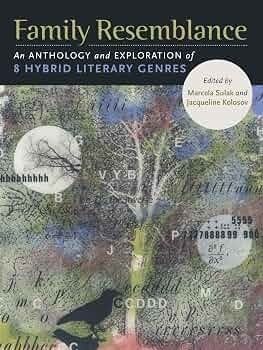
Book cover with layered text, foliage, and abstract photographic textures

Between Form and Freedom: How Hybrid Collections Defy Publishing Categories

The Architecture of Modern Fracture

Contemporary literature increasingly distrusts the clean borders once drawn between poetry, essay, memoir, and fiction. A poem may carry the evidentiary pressure of a document; an essay may move by image, rhythm, and association; a personal narrative may interrupt its own chronology to question the reliability of memory. Such writing does not represent a failure to choose a genre. It reflects a more accurate understanding of how experience is actually perceived, remembered, and articulated.

The pressures of modern life make this formal restlessness especially legible. Attention is frequently divided, identities are layered, and private histories are shaped by public systems that cannot be understood through a single register. The mind may move from an image to an argument, from bodily sensation to historical fact, within a single moment. Hybrid writing gives that movement a deliberate architecture. Its fragmentary appearance can therefore be highly controlled, allowing discontinuity to become not a defect but a method of truth.

A hybrid collection that brings together verse, micro-memoir, and critical reflection should be understood as an essential cultural artifact rather than a marginal curiosity. It records the conditions under which contemporary consciousness operates while preserving the intensity of literary form. Its significance lies not merely in combining materials, but in discovering what becomes possible when those materials are made to challenge, revise, and illuminate one another.

Open illustrated book resting on a weathered wooden table
Hybrid writing gives fragmented experience a deliberate structure, allowing different forms to deepen one another rather than compete for authority.

The Anatomy of Interactivity Across Form

Susanne Paola Antonetta offers a particularly useful account of genuine hybridity. In the interview “On Hybridity”, hybridity is defined not as the simple accumulation of genres but as an interaction among different modes of meaning-making. Language, visual material, documentation, genre, and image must exert pressure on one another. An illustration that merely decorates a poem does not create a hybrid form; a photograph that changes how the accompanying prose is interpreted does.

This principle distinguishes a serious hybrid collection from a superficial collage. The most compelling works establish a cross-current between their components, so that each mode alters the reader”s understanding of the others. A lyric passage may compress an emotional event that a prose section later contextualizes. A critical reflection may expose the assumptions concealed within a personal memory. A fragment may refuse the certainty suggested by a completed narrative. The resulting work asks not only what each section means, but why it has been shaped in that particular form.

The lineage is long. The history of prose poetry demonstrates how writers have repeatedly dissolved the rigid distinction between verse and narrative exposition. Lyrical prose, poetic essay, epistolary meditation, and documentary fiction have all developed methods for joining compression with scope. Contemporary hybrid collections inherit this ambition while extending it through new combinations of memoir, criticism, visual structure, and digital influence.

  • Reciprocal form means that each mode changes the force of the others.
  • Strategic fragmentation uses gaps, shifts, and interruptions to represent the instability of memory or perception.
  • Modulated scale moves between the intimate instant and the wider historical or intellectual frame.
  • Formal consequence ensures that the structure does not merely contain the subject but actively performs it.

These mechanics matter because hybrid literature is not defined by novelty alone. Its success depends on necessity. When a writer turns from a paragraph to a stanza, or from testimony to analysis, the transition should reveal something that a single form could not hold. The most accomplished collections make these shifts feel inevitable in retrospect, even when they remain surprising in the moment.

Why Conventional Classifications Fail Contemporary Reality

Traditional publishing categories were designed to make books legible to commerce. Bookstores require shelves, retailers require metadata, and publicity departments need concise descriptions that allow a title to be positioned beside comparable works. These systems are practical, but they are poorly suited to manuscripts whose central achievement lies in refusing a single classification. A collection that is simultaneously poetry, memoir, and criticism can become difficult to place before its artistic value has even been considered.

The difficulty is intensified by expectations surrounding point of view and narrative contract. Conventional publishing guidance often treats first person and third person as strategic choices within recognizable forms. First person offers immediacy and subjective immersion, while third person can widen perspective and disclose information beyond one character”s awareness. Hybrid writing may use both, or may abandon stable narratorial identity altogether. A lyric “I” can become a historical witness, a critical observer, or a constructed voice without announcing the transition in conventional terms.

This flexibility is not evasive. Trauma, migration, illness, inherited memory, and contested identity often resist a smooth chronological account. A personal history may require the precision of documentary prose, the silence of the fragment, and the associative force of poetry. Jane Friedman”s discussion of nonfiction techniques makes a related point: narrative, character, suspense, conflict, and an arc of change can deepen factual writing without compromising its credibility. Hybrid authors extend that principle by allowing several kinds of truth to occupy the same book.

Publishing expectation Hybrid alternative Literary consequence
One dominant genre Several mutually dependent modes Meaning emerges through formal tension
Stable narrative voice Shifting or layered speakers Identity becomes process rather than fixed position
Linear progression Fragments, returns, and juxtapositions Memory and interpretation shape chronology
Single shelf category Cross-category readership The book travels between literary communities

Metadata may therefore describe a hybrid book imperfectly, but imperfect classification does not diminish its cultural clarity. Indeed, the friction between manuscript and marketplace can reveal how narrowly literary institutions have defined readability. Some authors respond through independent publishing, specialist presses, or carefully framed descriptions that foreground the work”s governing question rather than its category. The objective is not to evade the reader”s expectations, but to establish a more generous contract with them.

Independent Presses as Champions of Boundary-Breaking Art

Small and university presses have long provided the curatorial courage required by uncategorizable literature. Their lists can make room for books whose commercial position is uncertain but whose artistic logic is unmistakable. Such publishers often evaluate a manuscript through sustained attention to voice, structure, and cultural significance rather than through a narrow comparison with established sales categories. Their editorial decisions can give emerging writers the freedom to develop forms that larger systems might regard as difficult to market.

This work belongs to a broader cultural resurgence of poetry and poetic thinking. As examined in Kevin Stein”s Poetry”s Afterlife, verse has not withered in modernity. It has developed new lives across schools, public libraries, universities, communities, and digital spaces. Stein”s book itself combines memoir, scholarship, and personal essay, offering a persuasive example of the very hybridity it describes. Its argument is not that poetry has survived unchanged, but that poetry remains active because it continually discovers new settings and forms.

Independent publishing also benefits from creative pivots. Darien Hsu Gee”s account of moving among fiction, nonfiction, memoir, essays, poetry, and micro-memoir illustrates how writers can resist the idea that a literary career must follow a single route. Her micro-memoir initiative, developed during the pandemic and connected with the Hali”a Aloha line, demonstrates how small forms can create accessible entry points into testimony and collective reflection. Such projects are not merely alternative products. They cultivate communities of readers and writers around a shared recognition that brevity, incompleteness, and multiplicity can carry substantial literary force.

  • They identify manuscripts whose strongest qualities may be obscured by conventional categories.
  • They support editorial development suited to unusual structures rather than forcing uniformity.
  • They create patient readerships through careful curation and sustained cultural conversation.
  • They allow authors to make formal risks without reducing literary ambition to immediate market clarity.

The relationship between daring editors and devoted readers is reciprocal. A press can introduce an unfamiliar form, but readers determine whether that form acquires a lasting life. When an imprint consistently demonstrates confidence in challenging work, its catalogue becomes a form of critical argument. It tells the literary field that ambiguity, formal intelligence, and emotional complexity are not obstacles to recognition. They are among the qualities recognition should be designed to honor.

The Reader as Co-Creator in the Space Between

Reading a hybrid collection is an active cognitive experience. The reader must adjust expectations as the book moves from lyric compression to documentary detail, from scene to meditation, or from argument to image. These transitions create interpretive work, but they also produce a distinctive intimacy. Instead of receiving a single, authoritative route through the material, the reader is invited to notice echoes, contradictions, omissions, and changes in scale.

This activity belongs to a wider culture of multimodal literacy. Nonfiction graphic narratives, for example, combine visual and verbal communication to address history, science, medicine, biography, and memoir. Their effectiveness depends on the reader”s ability to interpret several systems at once, rather than treating words as the sole vehicle of knowledge. Hybrid literary collections make a related demand within the space of the page. They ask readers to understand that form is not packaging placed around meaning; form is one of the ways meaning is made.

Contemporary audiences increasingly value authenticity, but authenticity no longer means unmediated confession. It can mean an honest acknowledgment of mediation: the admission that memory is selective, language is constructed, and every account has a position. Inventive form can therefore feel more truthful than a polished narrative that conceals its own methods. The reader becomes a co-creator not because the author withdraws authority, but because the work makes interpretation visible and consequential.

Embracing the Unruly Horizons of Contemporary Writing

Hybrid literature is not a temporary fashion produced by restless marketing departments. It is a lasting evolution of narrative, shaped by the complexity of contemporary experience and by writers unwilling to simplify that experience for the convenience of classification. Verse, micro-memoir, and critical reflection can coexist because consciousness itself is plural. The formal question is not which genre should prevail, but what arrangement of forms can best carry the work”s emotional, intellectual, and historical demands.

The writers who pursue this path accept commercial ambiguity in order to approach psychological truth with greater precision. Their books ask publishers to curate more imaginatively, critics to describe without reducing, and awards committees to enlarge the vocabulary of excellence. Such work deserves recognition not as an exception to literary culture, but as evidence of its vitality. Between form and freedom, the hybrid collection opens a space where contemporary writing can register fracture without surrendering shape, and where originality becomes a disciplined means of making the world newly legible.


Hands hold a stack of vintage books against a plain wall

Writing Youth from Within: Why the Under-40 Perspective Reshapes Global Fiction

The Raw Pulse of the Present Moment

There is a distinct pressure in literature written by those still moving through the conditions they describe. A mid-career novelist may look back on youth with the composure of hindsight, arranging its confusions into a pattern shaped by survival, memory, and consequence. The emerging writer, by contrast, often writes from inside the unsettled hour itself. The future remains provisional, the past refuses to settle, and the present arrives with the force of an interruption. This is not simply a matter of age. It is an aesthetic position, one that allows contemporary youth to appear not as a completed chapter but as an active state of negotiation.

Economic precarity, mass migration, ecological anxiety, and digital alienation have altered the tempo of that negotiation. Modern life is experienced through overlapping alerts, contracts, crises, images, and obligations, with private feeling continually exposed to public systems. The most compelling international writers under 40 do not merely document these pressures. They transform them into rhythm, syntax, structure, and voice. Their work offers a vital immediacy, capturing a generation that is learning how to desire, work, belong, and remember while the structures that once promised stability continue to recede.

Close-up of a person writing in a notebook with a blue pen
Writing from within uncertainty allows emerging authors to turn the pressures of the present into new forms of literary expression.

Living Precarity Without the Safety of Retrospect

Traditional coming-of-age fiction often imagines youth as a passage toward coherence. The protagonist leaves home, encounters social conflict, discovers a vocation or moral vocabulary, and emerges with some clearer sense of self. Even when the journey is painful, the narrative can imply that adulthood will provide a firmer ground. Contemporary young writers are less able, and often less willing, to make that promise. Their characters may be educated yet underemployed, globally connected yet socially isolated, and materially independent only through debt, shared housing, temporary contracts, or invisible family support.

This shift changes the emotional grammar of the novel. The young person is not always progressing toward a stable identity, because stability itself has become unevenly distributed. Class fragility appears in details that older narratives might treat as background: the calculation of a rent increase, the anxiety of an unpaid invoice, the disappearance of workplace protections, or the shame attached to needing help. The open-access collection Re-Imagining Class places precarity alongside intersectionality, emphasizing that class is not only an economic relation but also an identity and a lived subjective experience. That framework is particularly useful for reading debut fiction in which race, gender, disability, migration status, and labor conditions shape one another rather than appearing as separate themes.

  • Work is represented as unstable infrastructure rather than a dependable route to adulthood.
  • Migration becomes a condition of survival, aspiration, and emotional fracture, not merely a journey between national settings.
  • Family can function simultaneously as refuge, obligation, inheritance, and economic safety net.
  • Coming of age is frequently portrayed as adaptation without guaranteed arrival.

Current narratives also complicate the inherited bildungsroman by questioning whose development has historically counted as universal. The adolescent or young adult may be navigating several systems at once: a labor market organized around flexibility, a border regime that determines mobility, and a social world in which visibility can bring both recognition and surveillance. Alexandra Perisic”s study Precarious Crossings describes immigrant narratives in French, Spanish, and English as texts shaped by debt, labor insecurity, environmental crisis, and a multilingual Atlantic. Such fiction does not reduce globalization to cultural exchange. It reveals the unequal conditions under which movement takes place and the new forms of attachment created across borders.

Institutional Recognition and the Rise of Emerging Voices

Literary prizes provide more than ceremonial endorsement. At their best, they create a public argument about what kinds of writing deserve attention now. The Swansea University Dylan Thomas Prize is especially significant because it recognizes exceptional literary talent aged 39 or under across poetry, fiction, short stories, and drama. Its age limit does not define youth as a subject, but it does acknowledge that early-career writing can possess a particular formal and historical charge.

The 2026 award illustrates the point with unusual clarity. American poet Sasha Debevec-McKenney won for her debut collection Joy Is My Middle Name, selected unanimously by judges who praised its energetic style, emotional intimacy, humour, and ability to condense large ideas. At 35, Debevec-McKenney writes about the movement from the twenties into the thirties while addressing sex, race, womanhood, addiction, sobriety, consumerism, and popular culture. The collection”s achievement lies not in treating these subjects as a generational checklist, but in finding a language capacious enough to hold their contradictions. Recognition from major platforms such as the Dylan Thomas Prize proves that writing produced in the crucible of early career volatility possesses undeniable cultural resonance.

Critical reception around emerging voices increasingly celebrates vulnerability, hybridity, compression, and stylistic risk. This does not mean that established writers lack formal ambition, nor that youth automatically produces innovation. The distinction is more subtle. Mid-career prose may benefit from accumulated authority, a developed readership, and a settled relationship with literary institutions. Emergent fiction often writes before those supports have solidified, and its uncertainty can become part of its method. It may move between essay, lyric, testimony, social media fragment, documentary record, and speculative scene because contemporary experience itself no longer respects inherited boundaries.

Established mid-career prose Emergent under-40 fiction
Often shaped by retrospective pattern and accumulated experience Frequently driven by immediacy, instability, and unresolved pressure
May privilege sustained narrative architecture Often embraces fragmentation, compression, and hybrid forms
Usually engages institutions from a position of greater familiarity May expose institutional power through lived vulnerability
Can convert crisis into historical perspective Records crisis while its consequences remain active

Digital Native Consciousness and the Reshaping of Form

For writers who came of age alongside smartphones, platforms, and permanent connectivity, fragmentation is not necessarily an experimental pose. It can be an accurate account of attention. A sentence interrupted by a notification, a memory triggered by an image, or an intimate confession shaped by the possibility of being seen online belongs to the ordinary texture of contemporary consciousness. The formal question is therefore not whether digital life should appear in fiction, but how deeply its structures have already entered the imagination.

Short sections, abrupt tonal changes, scrolling rhythms, embedded messages, and compressed scenes can render emotional hyper-connectivity with remarkable precision. The curated discussion of contemporary novels under 200 pages highlights how compression can intensify memory, identity, migration, grief, psychological unease, and modernity. Brevity in such work is not an absence of depth. It is often a way of reproducing the speed at which contemporary subjects process too much information while trying to protect a private interior life.

  • Fragmentation can imitate disrupted attention without reducing experience to distraction.
  • Compressed forms can place competing emotional states beside one another without forcing resolution.
  • Digital language can reveal intimacy, performance, surveillance, and loneliness at the same time.
  • Hybrid structures allow fiction to question the authority of any single medium or viewpoint.

Digital native consciousness also produces a complicated relationship with the market. Platforms reward recognisable identities, easily transmissible narratives, and the conversion of personal experience into public content. Writers may be encouraged to package marginality, trauma, or cultural specificity as a marketable proposition. The conversation documented in Writing For, Within, and Against the Market is valuable precisely because it treats literature”s relationship to publishing not as a simple opposition between artistic purity and commercial compromise. Emerging writers work within markets, against their pressures, and sometimes through them, turning the mechanisms of circulation into objects of scrutiny.

The most vital work preserves that tension rather than pretending to stand outside it. A novel may use the language of the feed while resisting the feed”s demand for instant legibility. It may borrow from pop culture, advertising, fandom, or online confession, then rearrange those materials into something slower and stranger. Such writing understands that rebellion is not always loud. Sometimes it consists in refusing to make suffering inspirational, identity neatly consumable, or political anger comfortably symbolic.

Cross-Border Polyphony Across Modern Global Landscapes

International fiction by younger authors is often shaped by movement across languages, cities, platforms, and family histories. The border may appear as a physical checkpoint, a visa application, an accent, a translation problem, or the invisible distance between inherited culture and present circumstance. Multilingualism can enter the texture of a work through untranslated phrases, shifting registers, or competing concepts of home. These choices do more than add local colour. They challenge the assumption that one language, nation, or cultural tradition can contain the whole of a life.

This cross-border perspective also dismantles provincialism through intersectional attention. Diasporic characters are not symbols of mobility alone; they are workers, lovers, children, citizens, outsiders, believers, skeptics, and people negotiating several forms of vulnerability at once. Perisic”s account of the Atlantic as a multipolar space, rather than a simple map of former colonial relationships, helps explain why contemporary young writers are so well placed to represent global connection without romanticising it. Their fiction can map the fractures produced by debt, migration controls, multinational power, environmental damage, and uneven access to belonging. Early-career storytellers often inhabit these fractures not as distant subjects of research but as the conditions through which the present is known.

Embracing the Unfiltered Vanguard of Modern Storytelling

The under-40 perspective permanently expands contemporary world literature because it changes what counts as literary evidence. The unstable contract, the crowded apartment, the border crossing, the algorithmic image, the multilingual household, and the exhausted body are not peripheral details. They are central forms of knowledge. Writers who encounter these realities without the shelter of retrospective closure can give them a texture that is immediate, contradictory, and formally alive.

Readers, critics, editors, and institutions should therefore engage with emerging work on its own terms, resisting the temptation to measure every new voice against the settled architecture of an earlier generation. The cultural imperative is not to celebrate youth uncritically, but to make serious room for writing crafted from within the storm. Literature born amid historical friction may be unsettled, hybrid, compressed, and difficult to classify. That difficulty is part of its value. It records a world still becoming, and in doing so gives contemporary fiction the raw pulse required to imagine what comes next.

Vintage broadcast microphones evoking the sound of radio drama

The Architecture of Sound: How Under Milk Wood Redefines Modern Prose Cadence

Reclaiming Prose from the Algorithmic Flatline

Contemporary fiction is composed under a new kind of editorial pressure. Digital writing tools reward clarity, consistency, and predictive ease, while machine-assisted phrasing tends to smooth away the irregularities that make a sentence recognisably human. The result is not necessarily bad prose. It is often grammatical, efficient, and perfectly serviceable. Yet efficiency can become a form of aesthetic impoverishment when every sentence arrives with the same weight, the same pacing, and the same frictionless logic. For writers seeking a more distinctive literary voice, the central question is therefore acoustic as much as semantic: what does the sentence do in the mouth and in the inward ear?

Dylan Thomas”s Under Milk Wood offers an unusually vivid answer. Created as a radio play and built for voices, it treats language as atmosphere, percussion, movement, and communal presence. Its famous opening, “To begin at the beginning,” immediately establishes a theatrical invitation, while “the sloeblack, slow, black, crowblack, fishingboatbobbing sea” demonstrates how sound can make a landscape physically apprehensible. Thomas”s compounds do not merely decorate description. They compress time, colour, motion, and vocal emphasis into verbal structures that seem to breathe. The play”s fictional Welsh village of Llareggub becomes audible before it becomes fully visible.

For emerging novelists and essayists, the lesson is not to imitate Thomas”s vocabulary. It is to recover his seriousness about cadence. A sentence can function as an acoustic instrument, carrying information through stress, pause, recurrence, vowel colour, and the texture of consonants. Thomas”s wartime broadcasts and radio work helped shape this intimate, lyrical mode, and his influence on generations of poets remains inseparable from that attention to sound. The following techniques show how contemporary prose can regain rhythmic individuality without abandoning narrative economy.

Open blank notebook with a wooden pencil on a wooden desk
Distinctive prose begins in deliberate attention: drafting gives writers space to hear cadence, test variation, and preserve the human irregularities that make a voice memorable.

The Mechanics of Auditory Compounding

Thomas”s most memorable compounds are acts of compression. “Starless and bible-black,” from the opening of Under Milk Wood, joins astronomical absence to scriptural darkness. The phrase is not simply a vivid synonym for night. “Starless” describes what cannot be seen, while “bible-black” introduces moral, cultural, and tactile associations. Darkness becomes old, absolute, and somehow legible. The compound operates simultaneously as image, rhythm, and tonal instruction.

Compounding can also create the sensation of perception arriving too quickly for orderly syntax. A hyphenated phrase such as “rain-darkened” binds event and condition together. An unhyphenated collision can feel more unstable, as in Thomas”s “fishingboatbobbing,” where noun, action, and visual rhythm become one continuous movement. The writer”s task is to determine what kind of pressure the compound should exert. It may accelerate description, intensify a psychological state, imitate local speech, or make separate objects feel fused within a character”s consciousness.

Flat syntax Compounded sonic texture
The boats moved on the dark sea. The boats bobbed through the sloeblack sea.
She entered a wet, cold street. She entered the rain-bitten, coldstreet dark.
He was nervous before the interview. Interview-nervous, he polished the already-polished table.

The difference is not automatically a matter of quality. A compounded sentence earns its force only when its compression corresponds to the scene. Writers should ask whether each collision reveals pressure that ordinary syntax would disperse. A compound can carry character: a child may perceive “dogbarkingdark,” while a bureaucrat may register “procedural-grey morning.” It can also carry social atmosphere, especially when the language belongs to a particular community or emotional register. The useful principle is restraint. Select one or two charged compounds, then allow surrounding sentences to remain comparatively plain so that the heightened language has somewhere to resonate. Guidance on using poetic devices in prose similarly stresses that alliteration, consonance, and assonance become most effective when they are purposeful rather than continuous.

Counter-Rhythms and Metric Polyphony

Standard subject-verb-object syntax is indispensable, but it can become metronomic when every sentence proceeds with the same grammatical confidence. Thomas interrupts that regularity through reversals, accumulations, delayed verbs, and shifts in stress. The result is a form of metric polyphony, in which several rhythmic patterns compete. Iambic movement, with its rising beat, may propel a sentence forward, while trochaic openings or dactylic clusters interrupt that momentum. The reader experiences not an abstract pattern but the bodily fluctuation of attention.

Llareggub”s nocturnal waking scenes provide a useful model because the village is not presented through a single stable consciousness. Its residents surface in fragments, dreams, memories, and private obsessions. A sentence may surge through a list, hesitate at a caesura, and then end in a blunt monosyllabic stop. Such syntax can imitate thought before it has become explanation. The rhythm of perception is rarely smooth. It gathers, stumbles, revises, and suddenly recognises.

  • The gathering movement begins with accumulation. Images, names, sensory details, or clauses collect until the sentence feels populated by more experience than it can comfortably contain.
  • The suspended movement introduces a pause, interruption, or syntactic delay. A comma, parenthesis, or withheld verb creates the sensation of breath held in uncertainty.
  • The striking movement ends with a short clause, a hard consonant, or an unexpected image. The sentence lands rather than merely concluding.

These movements can be adapted to contemporary fiction without producing theatrical imitation. A crowded city morning might gather through a breathless catalogue of buses, screens, shoes, and overheard fragments; a moment of dread might suspend the main verb until the character notices the unopened door; a scene of violence might abandon lyric expansion for abrupt stops. The important distinction is between rhythm that emerges from embodied circumstance and rhythm applied as ornament. Even apparently spare prose can be musical. The often-discussed cadence of Hemingway, though the supplied source offers no substantive evidence beyond metadata, reminds writers that repetition, short clauses, and strategic variation can generate a recognisable beat without overtly poetic diction.

Layering Consonance, Assonance, and Sub-Vocal Texture

Silent reading is not soundless. Readers frequently hear language internally, and consonants shape that internal performance. Stops such as k, t, and d can give a sentence percussive force; fricatives such as s and f can produce abrasion or secrecy; nasals and liquids often soften or lengthen the line. Vowels establish a second field of resonance. Long open vowels may broaden a landscape, while clipped short vowels can make perception feel hurried or defensive.

Under Milk Wood orchestrates these possibilities rather than relying on one device in isolation. The play”s language moves between hard verbal knocks and liquid vowel passages, between the density of Welsh place and the expansiveness of the sea. This is why its prose-poetry remains effective when heard aloud. The sound does not sit above the meaning; it carries meaning into the body. A night scene formed from soft sibilants may make the reader lean inward, while a sequence crowded with stops can make the same darkness feel dangerous.

Sonic density must, however, remain tethered to narrative point of view. A lyrical description filtered through a grieving character should not sound identical to one filtered through a comic observer or an exhausted nurse. A useful comparison comes from discussions of poetic prose that distinguish gentle sounds suited to nocturnal movement from harder consonants suited to conflict. The principle extends beyond scene-setting. Sound can characterise social confidence, age, education, panic, intimacy, or estrangement. The strongest musical prose is therefore not merely beautiful. It is situated.

  1. Read the passage aloud without editing. Mark the places where breath runs short, where the voice naturally slows, and where a phrase feels difficult to pronounce. These are evidence about pace and emphasis.
  2. Underline recurring consonants and vowels. Do not count mechanically. Notice clusters. A passage full of t and k sounds may already possess a latent severity, while repeated long vowels may be diluting urgency.
  3. Identify the emotional job of the sound. Decide whether the texture should soothe, constrict, seduce, embarrass, or propel. Remove patterns that have no relationship to the scene”s pressure.
  4. Revise by contrast. Replace one or two neutral verbs, not every verb. Introduce sonic intensity at the point of emotional change, then return to simpler language so the alteration registers.
  5. Test the page in another voice. A sentence that works only in an imagined authorial delivery may be over-engineered. The language should invite performance without requiring a particular actor.

Translating Choral Architecture to Contemporary Fiction

Thomas”s great structural innovation in Under Milk Wood is the communal monologue. The village is not reduced to a chorus in the abstract, nor is it explained by a solitary narrator who stands outside its life. Instead, individual voices rise within a shared acoustic field. Dreams, gossip, desire, work, memory, and local history overlap. This offers long-form fiction a powerful alternative to the dominance of the isolated first-person consciousness. A novel can maintain distinct interiorities while allowing a place to possess a collective rhythm.

Radio drama is especially instructive because it must create spatial and emotional architecture through voice. Sound effects, entrances, repetitions, and changes in vocal register provide orientation without visual exposition. Prose can borrow this architecture through recurring phrases, patterned scene openings, interludes, and shifts among minor characters. Oral traditions offer another resource. In an account of the novel Hula, Jasmin Iolani Hakes describes hula as a storytelling practice preserving Hawaiian history, people, and mythology, while songs and chants shaped the novel”s relation to landscape and community. That example demonstrates how narrative music can be culturally specific rather than merely decorative.

Contemporary writers have repeatedly shown that poetic momentum can deepen worldbuilding. Hakes connects music to Hilo, Keaukaha, homesickness, land struggles, sovereignty, and rain, making sound a carrier of historical memory. RenĂ©e Branum has likewise described how the lyrical, sensory prose of A Child”s Christmas in Wales made reading aloud feel playful and communal, an experience that illuminates the social life of literary language. The broader lesson for novelists is to build a sound system for the world being created. Let occupations, ceremonies, migrations, family histories, and local speech patterns generate recurring rhythms. A choral novel succeeds when its voices are not interchangeable, yet remain part of the same living weather.

Tune Your Sentences for the Human Ear

Thomas”s example does not require contemporary writers to choose between acoustic richness and narrative economy. The most durable sentences do both. They deliver information while shaping breath, attention, and emotional temperature. A compound can replace an explanatory paragraph; a caesura can reveal hesitation more precisely than a stated emotion; a recurring vowel can bind separate scenes into an unconscious motif. Such choices are forms of narrative engineering, but they remain humane because they preserve unpredictability, texture, and local pressure.

The challenge is to resist language that arrives too smoothly, already standardised for approval. Read drafts aloud as theatrical scores. Listen for the sentences that march when they should stagger, the images that glitter without belonging to a consciousness, and the passages in which every line receives the same emphasis. Then revise toward variation: compression beside release, friction beside silence, the individual voice beside the communal murmur. Before prose is sent into the world, it should be tested not only for what it says, but for how it enters the human ear.